Skip to content

Art e-Facts 42


Edward Kienholz emerged as an artist at the same time as Jasper Johns and Robert Rauschenberg in the US and was part of a generation of artists born between two World Wars.

His practice was informed by the emerging Beat Culture of the late 1950s and early 1960s in California, and was central to the development of the early Los Angeles gallery scene. In 1972 Kienholz developed a life long collaborative partnership with Nancy Reddin, who continues to make work since his death in 1994.

Kienholz sculpture takes the form of life-size environments; walk-in ‘installations’ incorporating everyday objects which critique modern society, and the political climate of the day. Compelled by a deep sense of moral justice and a provocative sense of humour, these uncompromising artworks continue to have a searing energy and pose a direct challenge to the viewer.

Art e-Facts 42

[youtube=http://www.youtube.com/watch?v=-o5i0eF2AF4]

Chris Cunningham is internationally known for creating and directing music videos for artists such as Björk, Madonna, Portishead and Aphex Twin. In 1989, aged only 19 Cunningham was working on the satirical sketch show Spitting Image, sculpting character models, he later went to work as Stanley Kubricks head of animatronics and special effects for the feature film A.I.

In 2000 Cunningham exhibited Flex:

“…….a video which aims to awaken one’s senses through the sound of electronic music, unforgettable images of both sexual violence and breathtaking serenity”. Anthony d’Offay Gallery

Flex was shown for the first time in: Apocalypse: Beauty and Horror in Contemporary Art at the Royal Academy in London.

Art e-Facts 41

In 2006 the American artist Paul McCarthy transformed a London warehouse into a massive installation inspired by one of the most popular Disneyland rides Pirates of the Caribbean (and subsequently the Hollywood film).
‘The Caribbean Pirates Project’ was the result of a four year collaboration with his son Damon and consisted of drawings, sculptures, video works and large installations. The work was the centrepiece of his exhibition ‘La La Land Parody Paradise’ at the Whitechapel. The work has been described as being influenced by global capitalism as epitomised by the Disney corporation, and the US invasion of Iraq.
for further information click here

Art e-Facts 40


In 2003 the Imperial War Museum commissioned the British artist Steve McQueen to produce an official portrait of the Iraq conflict.
The former Turner prize winner (1999) is perhaps best known for his gallery based black and white silent films (the most famous being the restaging of the Buster Keaton stunt of the falling house in Deadpan.(1997).
McQueen was never likely to produce a standard representational work and so it was when in February 2007 the final work was unveiled at Manchester Central Library in the run up to the Manchester International festival.
The work is a collection of 100 (approx) stamps showing personal photographs of British soldiers killed in the conflict. McQueen worked with the full support of the families of the soldiers. The work faced strong opposition from the Ministry of Defence and the Royal Mail chairman Allan Leighton has refused to allow the stamps to be a real commemorative issue.

For the background and full story:

www.24hourmuseum.org.uk/nwh_gfx_en/ART17087.html

http://news.independent.co.uk/uk/this_britain/article2308407.ece

http://news.independent.co.uk/people/profiles/article2308397.ece

http://arts.guardian.co.uk/art/visualart/story/0,,2031797,00.html

Art e-Facts 39


Alison Watt was born in Greenock in 1965 and studied at the Glasgow School of Art from 1983 to 1988. She gained early recognition as a painter, winning the National Portrait Gallery’s annual award as a student, then a commission to paint the Queen Mother’s portrait in 1989. Inspired by the nineteenth century painter Ingres, Watt’s portraits often focus upon the drapery which is traditionally used as a backdrop for the sitter. In her recent large-scale works, the human figure is entirely absent, allowing the texture and folds of the fabric to take centre stage.

FOR INFORMATION ON FINE ART COURSES IN EDINBURGH PLEASE CLICK HERE

Art e-Facts 38


Born in Port Arthur, Texas in 1925, Robert Rauschenberg imagined himself first as a minister and later as a pharmacist. It wasn’t until 1947, while in the U.S. Marines that he discovered his aptitude for drawing and his interest in the artistic representation of everyday objects and people. After leaving the Marines he studied art in Paris on the G.I. Bill, but quickly became disenchanted with the European art scene. After less than a year he moved to North Carolina, where the country’s most visionary artists and thinkers, such as Joseph Albers and Buckminster Fuller, were teaching at Black Mountain College. There, with artists such as dancer Merce Cunningham and musician John Cage, Rauschenberg began what was to be an artistic revolution. Soon, North Carolina country life began to seem small and he left for New York to make it as a painter. There, amidst the chaos and excitement of city life Rauschenberg realized the full extent of what he could bring to painting.

Art e-Facts 37


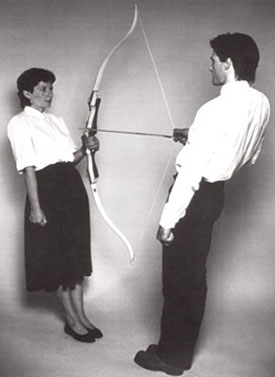
In 1976 Marina Abramović and Ulay began a decade of collaboration, during which the main concepts they explored were the ego and artistic identity.

Each performer was interested in the traditions of their cultural heritages and the individual’s desire for ritual. Consequently, they decided to form a collective being called “the other,” and spoke of themselves as parts of a “two-headed body.” They dressed and behaved like twins, and created a relationship of complete trust.

Rather than concern themselves with gender ideologies, Abramović/Ulay explored extreme states of consciousness and their relationship to architectural space.

In discussing this phase of her performance history, Abramović has said: “The main problem in this relationship was what to do with the two artists’ egos. I had to find out how to put my ego down, as did he, to create something like a hermaphroditic state of being that we called the death self.”

To create this “Death self,” the two performers devised a piece in which they connected their mouths and took in each other’s exhaled breaths until they had used up all of the available oxygen. Precisely seventeen minutes after the beginning of the performance they both fell to the floor unconscious, their lungs having filled with carbon dioxide. This personal piece explored the idea of an individual’s ability to absorb the life of another person, exchanging and destroying it.

In 1988, both artists walked the Great Wall of China, starting from the two opposite ends and meeting in the middle. As Abramovic described it: “That walk became a complete personal drama. Ulay started from the Gobi desert and I from the Yellow Sea. After each of us walked 2500 km, we met in the middle and said good-bye.”

This marked the end of their relationship.

Art e-Facts 36

Martin Boyce came to prominence during the 1990s and is one of Scotland’s most internationally acclaimed artists. His work takes inspiration from the collapse of utopian ideals that once surrounded mid-century modernism and modernist design. In past works, Boyce has re-situated iconic modernist furniture in anti-heroic postures, and in Double Black Disaster (1999), an Eames chair is put to work as a door jam.

Boyces’ work can currently be seen at The Modern Instutute in Glasgow until March 30th and later this year in Sculpture-Projects, Munster 07.


Art e-Facts 35


‘The one thing to say about art is that it is one thing. Art is art-as-art and everything else is everything else. Art-as-art is nothing but art. Art is not what is not art.’

This opening statement from the article ‘Art as Art’ by American Abstract painter Ad Reinhardt clearly advocates the complete seperation of art from life. He goes on to suggest that art should be:

‘…non-objective, non-representational, non-figurative, non-imagist, non-expressionist, non-subjective.’

This advocation of pure abstraction provided a conceptual platform for the ‘pure’ abstract paintings Reinhardt had been working on since the early 1950’s.

The article was first published in Art International, VI, no 10, Lugano, December 1962.

FOR INFORMATION ON FINE ART COURSES IN EDINBURGH PLEASE CLICK HERE

Art e-Facts (supplemental)

THE EDITOR WOULD LIKE TO APOLOGISE TO THOSE WHO NOTICED THE LACK OF FArt e-Facts OVER THE WEEKEND. THIS WAS DUE TO ILL HEALTH.

HOWEVER AS A RESULT THE EDITOR HAS DECIDED THE WEEKENDS ARE BETTER SPENT:

  • IN THE STUDIO MAKING WORK.
  • VISITING GALLERIES.
  • READING AND NOT REMEMBERING.
  • HAVING FAMILY FUN DAYS.
  • BEING IN BED.
  • BEING IN BED BEING ILL.

THEREFORE FACT OF THE DAY WILL ONLY APPEAR MONDAY TO FRIDAY.

Art e-Facts 34

Downpresserer by Graham Fagen was produced following a research trip to Jamaica in 2006.

The work was commissioned as part of a year-long programme of events run by Glasgow City Council to mark the bicentenary anniversary of the Abolition of the Slave Trade Act, and part of the exhibition tells the story of the attempts of Robert Burns, who was appalled by the slave trade, to become a bookkeeper on a plantation in Jamaica.

Downpresserer exemplifies Fagen’s ongoing interest in combining elements of Scottish national heritage (such as the writings of Robert Burns) with that of the West Indies (Jamaican reggae). The title of the show, comes from the song Downpresser Man by the celebrated Jamaican musician Peter Tosh (1944-87). A photographic portrait of Tosh’s mother, Mama Tosh, is included in the exhibition alongside a video installation of an impromptu performance of Robert Burns’s poem Slave’s Lament. Fagen made both these works on a research trip to Jamaica in 2006.

Downpresser can be seen at Glasgows Gallery of Modern Art until May 28th.

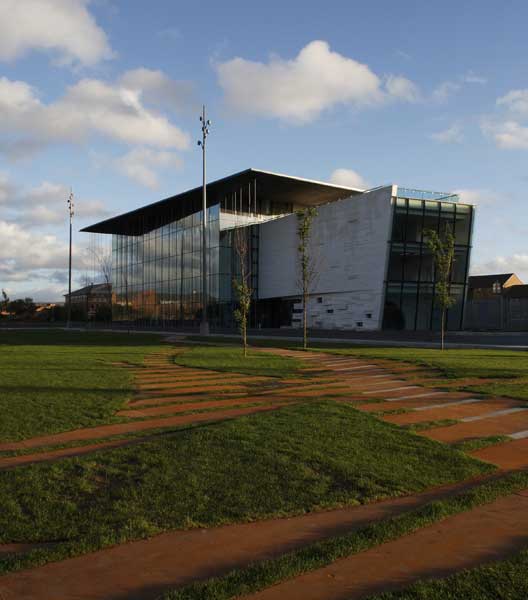
MIMA: Middlesbough Insitute of Modern Art

mima_eaa060207_marcusginns.jpg

The Middlesbrough Institute of Modern Art (MIMA) opened its doors to the public on the 27th of January 2007 with its inaugural exhibition Draw. The exhibition features a number of conversations around the legacy of drawing and features seven modern masters recognised for their contribution to 20th century art, with seven living artists.

The resulting dialogues created around the practice of drawing encourage us to engage with the work of one artist through the ideas of another and to expand our understanding of drawing.

The exhibition demonstrates MIMA’s commitment to modern as well as contemporary art with a collection and exhibition policy that focuses on art from 1900 to the present.

Draw will run at MIMA until April 22nd

www.visitmima.com

MIMA was designed by: Erick van Egeraat Associated Architects

Art e-Facts 32


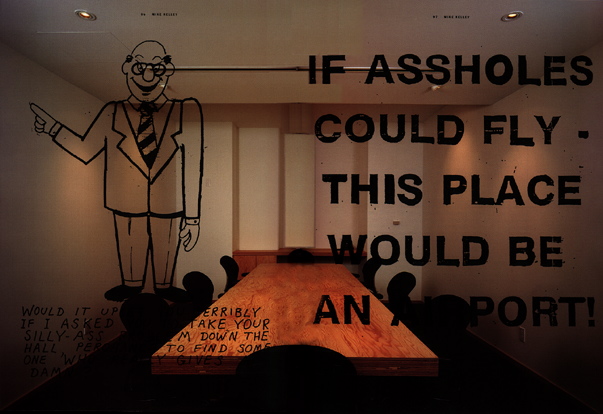
Mike Kelley was a founding member of the band ‘Destroy all Monsters’ and was replaced by then ex Stooges guitarist Ron Ashton. He left the Detroit music scene in 1978 and moved to LA to pursue his interest in art. He is now considered to be one of the most influential artists to come out of the US art scene in the 1980s. However, he has continued to parallel his art career with his interest in sound and has collaborated musically with (amongst others) the artists Paul McCarthy and Tony Oursler.

http://www.mikekelley.com/

Art e-Facts 31


Through the media of photography Idris Khan creates dramatic and emotive images resembling charcoal drawing and oil painting more than photography. Using transparent layers of photographs he builds up images that have the richness, intensity and luminosity of any oil painting.

Khan explores the tensions of authorship by photographing famous images and texts and reworking them. To this end he has made his own visual interpretations of the Koran and works by artists such as William Turner, and Bernd and Hilla Becher, famous for their vast photographic collections of buildings and industrial sites.

“it’s obviously not about re-photographing the photographs to make exact copies, but to intervene and bring a spectrum of feelings – warmth, humour, anxiety – to what might otherwise be considered cool aloof image. You can see the illusion of my hand in the layering. It looks like a drawing. It’s not systematic or uniform.”
Victoria Miro Gallery

Idris Khan was born in 1978 and graduated from RCA with his Masters in Fine Art in 2003.

Courtesy: C. Woods

Art e-Facts 30


Mona Hatoum started her career making performance art in the 1980s that focused with great intensity on the body. Since the beginning of the 1990s, however, her work moved increasingly towards large-scale installations that aimed to engage the viewer in conflicting emotions of desire and revulsion, fear and fascination. In her singular sculptures, Hatoum has transformed familiar, every-day, domestic objects such as chairs, cots and kitchen utensils into things foreign, threatening and dangerous.

Hatoum was born into a Palestinian family in Beirut, Lebanon in 1952 and now lives and works in London and Berlin.

Art e-Facts 29

[youtube=http://www.youtube.com/watch?v=VRkNrWp6tLg]

Brian Eno (born Brian Peter George St. John le Baptiste de la Salle Eno in 1948) studied at Winchester school of Art before being a founder member of the art-rock band Roxy Music. He is accredited as the father of Ambient Music and has produced and collaborated with a wide range of artists, musicians and theorists including: Nico, John Cale, U2, Laurie Anderson, David Bowie, Fluxus movement, Devo, Talking Heads and David Lynch too name a few.

“Pop music and Russian constructivism made me want to be an artist,”

He regards himself as a ‘non-musician’ and is heavily engaged with ‘generative’ music and art, artworks that self evolve and are ever changing.
His installation ‘Constellations (77 Million Paintings)’ is at the Baltic, Gateshead, until 15 April 07 and ‘Luminous (77 Million Paintings)’ is at Selfridge’s, London, until 17 March 07. The installations are created using Eno’s specially developed computer programme, 77 Million Paintings. Eno uses over 300 of his own hand-drawn images, which are manipulated by the software, creating millions of visual ‘generative’ combinations.

Courtesy: N. Manning

Art e-Facts 28


Carsten Höller is the seventh artist to undertake the challenge of creating an artwork to fill Tate Modern’s vast Turbine Hall as part of the Unilever Series. Test Site continues his exploration of communal human experience. For Höller, the experience of sliding is best summed up in a phrase by the French writer Roger Caillois as a ‘voluptuous panic upon an otherwise lucid mind’.

Test Site runs until the 15th April at Tate Modern.

Art e-Facts 27


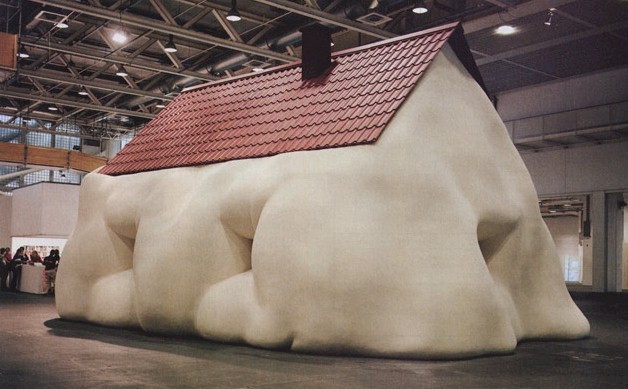
Austrian artist Erwin Wurm, creates works which liberate objects from their familiar context, giving them new meaning. Objects acquire illogical shapes and appearances, and the resulting distance created between us and the everyday raises fundamental questions about art, culture and the truths we take for granted.

Fat House (2003) is a life-size fantasy, cartoon house and forms part of the Fat series, which questions what minimum characteristics an object requires to be considered sculpture.

Truck(2005), on the other hand, takes the form of a vehicle curved up and fixed to the wall of the gallery space. Both works investigate with humour and sophistication how everyday objects can become sculpture, inviting us to reconsider the world we inhabit.

Art e-Facts 26

According to its proponents, dada was not art — it was “anti-art“. Dada sought to fight art with art. For everything that art stood for, Dada was to represent the opposite. Where art was concerned with aesthetics, Dada ignored aesthetics. If art were to have at least an implicit or latent message, Dada strove to have no meaning — interpretation of Dada is dependent entirely on the viewer. If art is to appeal to sensibilities, Dada is to offend.

It is ironic that Dada became an influential movement in modern art, a commentary on order and the carnage Dadaists believed it wreaked. Through this rejection of traditional culture and aesthetics they hoped to destroy traditional culture and aesthetics.

Art e-Facts 25


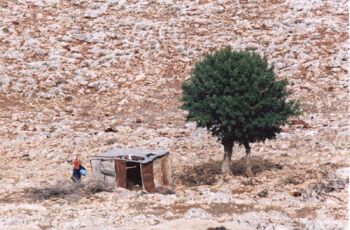
The photographic works of Palestinian artist Ahlam Shibli (*1970, “Arab al-Shibli”, Palestine) deal with current living conditions of the Palestinian population living in Israel and with the various consequences arising from living together in a state of permanent conflict.

Shiblis’ intention to show the everyday life of the Palestinian population requires intensive research on location, interviews with the villagers and the subtle observation of the rural and the urban environment.

An exhibition of Shiblis work can currently be seen at Dundee Contemporary Art Centre until April 1st. The exhibition comprises two vast sets of photographs which characterise her thoughtful, compelling practice.

In the two groups of photographs presented – Goter and Trackers – the people depicted are all – like Shibli herself – Arabs of Bedouin descent.

http://www.annadwa.org/cave/gallery_archive/ahlam_shibli.htm

http://www.dca.org.uk/exhibitions/current.asp