Skip to content

Art e-Facts 21


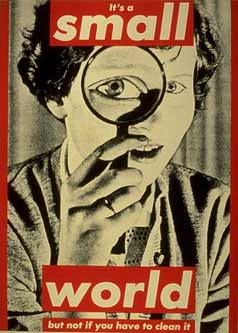
In 2005 Barbara Kruger was honoured at the 51st Venice Biennale with the “Golden Lion” for Lifetime Achievement.

Much of Kruger’s graphic work consists of black-and-white photographs with overlaid captions set in white-on-red Futura Bold Oblique. The phrases included in her work are usually declarative, and make common use of such pronouns as “you,” “I,” “we,” and “they.” The juxtaposition of Kruger’s imagery with text containing criticism of sexism and misogyny and the circulation of power within cultures is a recurring motif in the work.

Kruger is currently a professor at the University of California at Los Angeles.

http://www.barbarakruger.com/

Art e-Facts 20


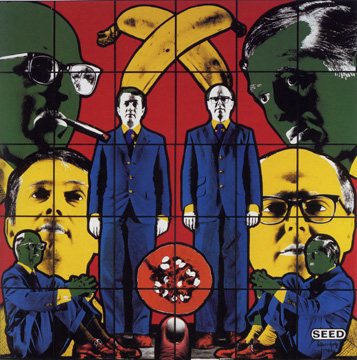
Gilbert & George place themselves, their thoughts and their feelings at the centre of their art, and almost all of the images they use are gathered within walking distance of their home in London’s East End. Yet their pictures capture a broad human experience, encompassing an astonishing range of emotions and themes, from rural idylls to gritty images of a decaying London; from fantastical brightly-coloured panoramas to raw examinations of humanity stripped bare; from sex advertisements to religious fundamentalism.

http://www.tate.org.uk/modern/exhibitions/gilbertandgeorge/

Art e-Facts 19


“In the future, everyone will be world-famous for fifteen minutes” Andy Warhol prophesised in 1968 in relation to his own, and media interest in the notion of celebrity. He got so tired of people asking him about the famous quote that he tried to relieve his boredom by misquoting himself in a number of ways including “In the future fifteen people will be famous” and “in fifteen minutes everybody will be famous”

Courtesy: J. Temple & C. Walker

Art e-Facts 18

This photograph of Marcel Duchamp, taken by Man Ray in 1921, shows Marcel Duchamp in the role of Rrose Selavy, the artists female alter ego. To introduce Selavy to the public this femme savante (intellectual woman) was photographed by Man Ray as a form of birth certificate of the ‘daughter without mother’.

Dressed in full regalia of furs, rings, pearls and hat and photographed against a neutral background, appearing as a women of high society and apparently questionable morals Duchamp emphasised the ambiguity and clouding of sexual boundaries. To add to the femininity of the portrait Ray and Duchamp touched up the photo with pencil and ink. The name of the female alter ego is also a cryptic comment – the French pronunciation can also be interpreted as ‘Eros, c’est la vie – Eros, that’s life’ Duchamp believed in the universal understanding of eroticism.

Courtesy: D. McLachlan

Art e-Facts 17


German artist Rebecca Horn’s practice involves Installations, performance art, body extensions/ sculpture, kinetic / mechanised sculpture, poetry, books and film.

Her work draws parallels between the body as object and human emotion as non-linear narrative, which stems from working whilst bedridden with severe ill health in her early 20’s. Her work repeatedly asks the question “ who gets to make the truth within our culture?’ and are markers or mythological metaphors of “human truths”.

The Installations are often conceptually, aesthetically and emotionally site – specific, often being informed from her own experiences as an invalid, female artist and young German growing up in the wake of WWII for example “ Concert for Buchenwald”.

Horn utilises an extensive range of media including, feathers, masks, strapping and restraints, musical instruments and coloured pencils, She literally draws with her head!

The Video below shows Horn cutting her hair.

[youtube=http://www.youtube.com/watch?v=cVdtIjdGsgU]

Courtesy: N. Manning

Art e-Facts 16

Marc Quinn‘s ‘Alison Lapper Pregnant’ was unveiled in September 2005 in Trafalgar Square.

The sculpture was one of two works selected from an original shortlist of six other artists in March 2004 and endorsed by the Mayor of London, Ken Livingstone.

The sculpture, constructed in white marble, takes a unique approach to the fourth plinth. ‘Alison Lapper Pregnant’ celebrates the human spirit on a very large scale.

“The work considers questions of idealism, heroism, femininity, prejudice and identity,” Greg Hilty, director of visual arts and literature at Arts Council England, London.

“I regard it as a modern tribute to femininity, disability and motherhood. It is so rare to see disability in everyday life – let alone naked, pregnant and proud,”
Alison Lapper, with whom Quinn collaborated on the piece.

The second work, Thomas Schütte’s Hotel for the Birds will be installed in April.

The Fourth Plinth had remained empty for most of its 164-year history.

http://www.fourthplinth.co.uk

http://www.alisonlapper.com

Art e-Facts 15


The German artist Joseph Beuys was a member of the Luftwaffe during WWII, and was involved in a plane crash in Crimea in 1944. The pilot died, but Beuys survived and subsequently claimed that he was found critically injured by Tartar tribesman who smothered his freezing body with animal fat and felt in order to keep him alive. The artist had several reoccurring motifs in his works two of which were felt and fat, in direct relation to his account of his encounter with the Tartar tribe.

Courtesy: J. Temple & C. Walker

Art e-Facts 14


Although best known as the director behind Eraserhead, Blue Velvet and Twin Peaks David Lynch is also a prolific artist producing paintings, drawings, photography and video works.

Lynch enrolled in the School of the Museum of Fine Arts in Boston in 1966 for one year before leaving for Europe with the plan to study with Austrian expressionist painter Oskar Kokoschka. Though he had planned to stay for three years, Lynch returned to the US after 15 days.

A major retrospective of Lynch’s work opened last week in Paris.

http://www.thecityofabsurdity.com/

Art e-Fact 13: Lyn Lowenstein

frontcover.gif

Lyn Lowenstein began work on The Homophobic Alphabet in 1998 in response to the campaign to prevent the repeal of Clause 28 which restricted the ‘promotion of homosexuality’ by Local Government in Britain.

The project which continues today takes a number of forms including self contained works, limited edition prints and a spurious educational kit – a booklet and wall-chart distributed to Edinburgh’s Primary Schools to teach children about prejudice.

http://www.lyn.lowenstein.eu/

Art e-Facts 12

In spring of 2004, Rachel Whiteread was offered the annual Unileve Series commision toproduce a piece for the Tate Modern’s Turbine Hall. However, she delayes th acceptance for 5 to 6 months until she was confident she could conceive a work to fill the space.

In 1993. the band, KLF announced they would award the Turner Prize winner of that year £40,000 for the worst artwork. This award was significantly more than the £20,000 Turner prize award. Whiteread was awarded both these prizes. She initially refused to collect the KLF prize, but when they threated to perform a live burning of the money should it remain unclaimed, Whiteread collected the prize and donnated the £40,000 award to charity.

Courtesy of J. Duffy & C. Woods.

Art e-Facts 11

Juergen Teller was born in Erlangen, Germany in 1964. He studied at Bayerische Staatslehranstalt für Photographie in Munich, Germany before moving to London in the early 1980s. In the UK, Teller was introduced to the world of fashion photography and used his assignments at i-D, The Face, Index and W magazines as resources from which he could nurture his own photographic sensibility.

Selected works by Jurgen Teller are available to view at Inverleith House Gallery, Edinburgh until April 15th 2007

FOR INFORMATION ON FINE ART COURSES IN EDINBURGH PLEASE CLICK HERE

Art e-Facts 10

When the late Martin Kippenberger said ‘every artist is a human being’ it was a twist on Joseph Beuys’s famous proclaimation that ‘Everybody is an artist.’

Kippenberger was a prolific artist, best known for his mock-Neo-Expressionist style painting he also combined many differing styles and media in the production of sculpture.

Courtesy of C. Woods

Art e-Facts 9

The term Neo-Dada is associated with the work of artists Robert Rauschenberg and Jasper Johns. The term was first applied, in an un-attributed comment, in a 1958 issue of the American magazine Artnews .

The term refers to two aspects of the early 20th Century Dada movement. Firstly there was the connection through the use of ‘found’ objects and junk to create combines – which are hybrid painting – sculptures – which can be seen in the work of Rauschenberg and Schwitters and secondly there is the Dada-like sense of paradox and ambiguity which can be seen in the paintings of Jasper John with his use of numbers, maps, targets that fill the canvas.

Neo-Dada provided a bridge between abstract expressionism and pop art.

Courtesy of D. McLachlan.

Art e-Facts 8

Marlene Dumas was born in Cape Town i South Africa. From 1972 to 1975 she attended Cape Town University, where she studied for a BA in Visual Arts. She then completed her studies in Haarlem, in the Netherlands.
The majority of her works may be categorised as ‘portraits’, but they are not portraits in the traditional sense. Rather than representing an actual person, they represent an emotion or a state of mind. Themes central to Dumas’ work include race and sexuality, guilt and innocence, violence and tenderness.

Art e-Facts 7

The Guerrilla Girls is a group of feminist artists established in New York City in 1985 and is known for using guerrilla art) to promote women, and minorities, in the arts. Their traditional tactics included putting up posters decrying the gender and racial imbalance of artists represented in galleries.
One of their most famous posters was plastered across New York City buses in 1989. Its headline read, “Do women have to be naked to get into the Met. Museum?” According to the Guerrilla Girls, they conducted a “weenie count” at New York’s Metropolitan Museum of Art and found that less than 5% of the artists in the Met’s Modern Art sections were female, but 85% of the nudes were female.

http://www.guerrillagirls.com/

Art e-Facts 6

German artist Anselm Kiefer prduced a series of books which are so poisonnous to the touch that the assistants who fabricated them had to wear gloves.

Coutesy of I. Henderson

Art e-Facts 5

Maurizio Cattelan may be best known to British audiences for his sculpture of Pope Jean Paul II struck down by a meteorite yet the only Maurizio Cattelan in a British private collection is ‘Betsy’ a life size photo realist sculpture of the collectors Grandmother kept in a domestic fridge.

Art e-Facts 4

Considered “the most important American artist of his generation” by the New York Times in the mid 1990s, Mathew Barney is the man behind the Cremaster cycle – five films, comprising 12 lines of dialogue during 6.5 hours of “the most audacious, repulsive, seductive, annoying, frustrating, puerile, pretentious, hilarious, beautiful and original images you will see, with no clear plot, lashings of Vaseline and sculptural, visual and prosthetic references to all things sexual and reproductive.”

http://www.cremaster.net

Art e-Facts 3

In August 2006, the British Council announced that they had chosen Tracey Emin to produce a show of new work for the British Pavilion at the 52nd Venice Biennale in 2007. Emin will be only the second woman to produce a solo show for the UK at the Biennale, following Rachel Whiteread in 1997.

HAPPY VALENTINES !

Art e-Facts 2

In December 2004, Marcel Duchamp’s Fountain was voted the most influential artwork of the 20th century by 500 of the most powerful people in the British art world. This is testimony to the influence of Duchamp’s work, and the mark he has left on the art world.

http://www.understandingduchamp.com/