Skip to content

Art e-Facts 31


Through the media of photography Idris Khan creates dramatic and emotive images resembling charcoal drawing and oil painting more than photography. Using transparent layers of photographs he builds up images that have the richness, intensity and luminosity of any oil painting.

Khan explores the tensions of authorship by photographing famous images and texts and reworking them. To this end he has made his own visual interpretations of the Koran and works by artists such as William Turner, and Bernd and Hilla Becher, famous for their vast photographic collections of buildings and industrial sites.

“it’s obviously not about re-photographing the photographs to make exact copies, but to intervene and bring a spectrum of feelings – warmth, humour, anxiety – to what might otherwise be considered cool aloof image. You can see the illusion of my hand in the layering. It looks like a drawing. It’s not systematic or uniform.”
Victoria Miro Gallery

Idris Khan was born in 1978 and graduated from RCA with his Masters in Fine Art in 2003.

Courtesy: C. Woods

Art e-Facts 30


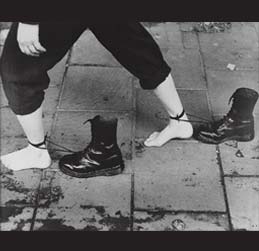
Mona Hatoum started her career making performance art in the 1980s that focused with great intensity on the body. Since the beginning of the 1990s, however, her work moved increasingly towards large-scale installations that aimed to engage the viewer in conflicting emotions of desire and revulsion, fear and fascination. In her singular sculptures, Hatoum has transformed familiar, every-day, domestic objects such as chairs, cots and kitchen utensils into things foreign, threatening and dangerous.

Hatoum was born into a Palestinian family in Beirut, Lebanon in 1952 and now lives and works in London and Berlin.

Art e-Facts 29

[youtube=http://www.youtube.com/watch?v=VRkNrWp6tLg]

Brian Eno (born Brian Peter George St. John le Baptiste de la Salle Eno in 1948) studied at Winchester school of Art before being a founder member of the art-rock band Roxy Music. He is accredited as the father of Ambient Music and has produced and collaborated with a wide range of artists, musicians and theorists including: Nico, John Cale, U2, Laurie Anderson, David Bowie, Fluxus movement, Devo, Talking Heads and David Lynch too name a few.

“Pop music and Russian constructivism made me want to be an artist,”

He regards himself as a ‘non-musician’ and is heavily engaged with ‘generative’ music and art, artworks that self evolve and are ever changing.
His installation ‘Constellations (77 Million Paintings)’ is at the Baltic, Gateshead, until 15 April 07 and ‘Luminous (77 Million Paintings)’ is at Selfridge’s, London, until 17 March 07. The installations are created using Eno’s specially developed computer programme, 77 Million Paintings. Eno uses over 300 of his own hand-drawn images, which are manipulated by the software, creating millions of visual ‘generative’ combinations.

Courtesy: N. Manning

Art e-Facts 28


Carsten Höller is the seventh artist to undertake the challenge of creating an artwork to fill Tate Modern’s vast Turbine Hall as part of the Unilever Series. Test Site continues his exploration of communal human experience. For Höller, the experience of sliding is best summed up in a phrase by the French writer Roger Caillois as a ‘voluptuous panic upon an otherwise lucid mind’.

Test Site runs until the 15th April at Tate Modern.

Art e-Facts 27


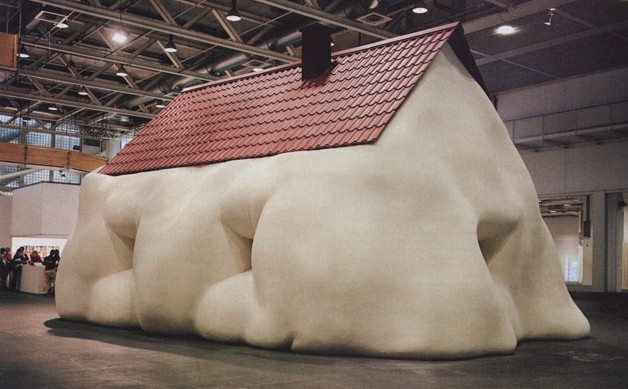
Austrian artist Erwin Wurm, creates works which liberate objects from their familiar context, giving them new meaning. Objects acquire illogical shapes and appearances, and the resulting distance created between us and the everyday raises fundamental questions about art, culture and the truths we take for granted.

Fat House (2003) is a life-size fantasy, cartoon house and forms part of the Fat series, which questions what minimum characteristics an object requires to be considered sculpture.

Truck(2005), on the other hand, takes the form of a vehicle curved up and fixed to the wall of the gallery space. Both works investigate with humour and sophistication how everyday objects can become sculpture, inviting us to reconsider the world we inhabit.

Art e-Facts 26

According to its proponents, dada was not art — it was “anti-art“. Dada sought to fight art with art. For everything that art stood for, Dada was to represent the opposite. Where art was concerned with aesthetics, Dada ignored aesthetics. If art were to have at least an implicit or latent message, Dada strove to have no meaning — interpretation of Dada is dependent entirely on the viewer. If art is to appeal to sensibilities, Dada is to offend.

It is ironic that Dada became an influential movement in modern art, a commentary on order and the carnage Dadaists believed it wreaked. Through this rejection of traditional culture and aesthetics they hoped to destroy traditional culture and aesthetics.

Art e-Facts 25


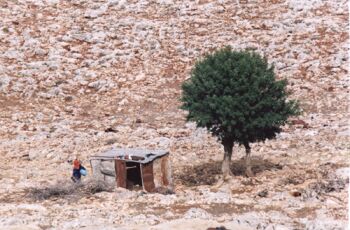
The photographic works of Palestinian artist Ahlam Shibli (*1970, “Arab al-Shibli”, Palestine) deal with current living conditions of the Palestinian population living in Israel and with the various consequences arising from living together in a state of permanent conflict.

Shiblis’ intention to show the everyday life of the Palestinian population requires intensive research on location, interviews with the villagers and the subtle observation of the rural and the urban environment.

An exhibition of Shiblis work can currently be seen at Dundee Contemporary Art Centre until April 1st. The exhibition comprises two vast sets of photographs which characterise her thoughtful, compelling practice.

In the two groups of photographs presented – Goter and Trackers – the people depicted are all – like Shibli herself – Arabs of Bedouin descent.

http://www.annadwa.org/cave/gallery_archive/ahlam_shibli.htm

http://www.dca.org.uk/exhibitions/current.asp

Art e-Facts 24


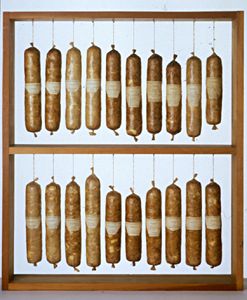
The German Swiss artist Dieter Roth (1930 – 1998) was an early pioneer of degradable artworks and made his first ‘baked’ sculpture in 1954. He went on to experiment further and made sculptures from chocolate, bread and other decomposable food stuffs. Remarkably, a significant number of the works still exist today. However, his artistic ouvre went much further than this use of edible materials and he also produced drawings, films, paintings and collaborated with a number of other artists including Richard Hamilton and Arnulf Rainer.

www.dieter-roth-museum.de/en/

Courtesy: J. Temple & C. Walker

Art e-Facts 23

[youtube=http://www.youtube.com/watch?v=iBgEjyn8ArM]

Aberdeen born Michael Clark (1962) is one of the worlds leading contemporary Dancers and Choreographers. He was classically trained at the Royal ballet but was highly immersed and influential in the artistic club and sub culture of the 1980’s. His performances are highly visual and often have specific references to contemporary art, for example the projection of Andy Warhol’s “Liz” and “The Great Rock and Roll Swindle” by Julien Temple in the production of Mmm…

Clark choreographs pieces to an eclectic range of music including The Fall, Laibach, Wire, Public Image Ltd., Stephen Sondheim, Sex Pistols and Igor Stravinsky. His practice is often collaborative and he has worked closely with Video Artists, Fashion Designers and Musicians including Charles Atlas, Leigh Bowery, Trojan, Bodymap, Sarah Lucas, The Anthony D’Offay Gallery and Mark e Smith and the Fall.
http://www.michaelclarkcompany.com/

Courtesy: N. Manning

Art e-Facts 22

Leeds born artist Marcus Harvey is best known for his large work depicting Moors murderer Myra Hindley, formed from white, grey and black stenciled handprints of children. This work was the centre of major controversy when it was installed at the 1997 Sensation exhibition.

The reaction to the work raised questions about the censorship of art and the legitimacy of using such controversial imagery. The painting had to be placed behind protective acrylic glass after it was attacked with ink and eggs by protestors.

Art e-Facts 21


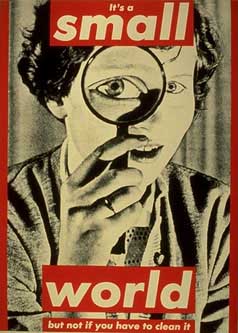
In 2005 Barbara Kruger was honoured at the 51st Venice Biennale with the “Golden Lion” for Lifetime Achievement.

Much of Kruger’s graphic work consists of black-and-white photographs with overlaid captions set in white-on-red Futura Bold Oblique. The phrases included in her work are usually declarative, and make common use of such pronouns as “you,” “I,” “we,” and “they.” The juxtaposition of Kruger’s imagery with text containing criticism of sexism and misogyny and the circulation of power within cultures is a recurring motif in the work.

Kruger is currently a professor at the University of California at Los Angeles.

http://www.barbarakruger.com/

Art e-Facts 20


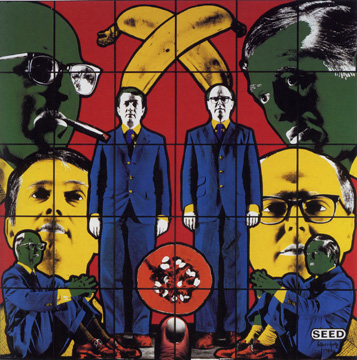
Gilbert & George place themselves, their thoughts and their feelings at the centre of their art, and almost all of the images they use are gathered within walking distance of their home in London’s East End. Yet their pictures capture a broad human experience, encompassing an astonishing range of emotions and themes, from rural idylls to gritty images of a decaying London; from fantastical brightly-coloured panoramas to raw examinations of humanity stripped bare; from sex advertisements to religious fundamentalism.

http://www.tate.org.uk/modern/exhibitions/gilbertandgeorge/

Art e-Facts 19


“In the future, everyone will be world-famous for fifteen minutes” Andy Warhol prophesised in 1968 in relation to his own, and media interest in the notion of celebrity. He got so tired of people asking him about the famous quote that he tried to relieve his boredom by misquoting himself in a number of ways including “In the future fifteen people will be famous” and “in fifteen minutes everybody will be famous”

Courtesy: J. Temple & C. Walker

Art e-Facts 18

This photograph of Marcel Duchamp, taken by Man Ray in 1921, shows Marcel Duchamp in the role of Rrose Selavy, the artists female alter ego. To introduce Selavy to the public this femme savante (intellectual woman) was photographed by Man Ray as a form of birth certificate of the ‘daughter without mother’.

Dressed in full regalia of furs, rings, pearls and hat and photographed against a neutral background, appearing as a women of high society and apparently questionable morals Duchamp emphasised the ambiguity and clouding of sexual boundaries. To add to the femininity of the portrait Ray and Duchamp touched up the photo with pencil and ink. The name of the female alter ego is also a cryptic comment – the French pronunciation can also be interpreted as ‘Eros, c’est la vie – Eros, that’s life’ Duchamp believed in the universal understanding of eroticism.

Courtesy: D. McLachlan

Art e-Facts 17


German artist Rebecca Horn’s practice involves Installations, performance art, body extensions/ sculpture, kinetic / mechanised sculpture, poetry, books and film.

Her work draws parallels between the body as object and human emotion as non-linear narrative, which stems from working whilst bedridden with severe ill health in her early 20’s. Her work repeatedly asks the question “ who gets to make the truth within our culture?’ and are markers or mythological metaphors of “human truths”.

The Installations are often conceptually, aesthetically and emotionally site – specific, often being informed from her own experiences as an invalid, female artist and young German growing up in the wake of WWII for example “ Concert for Buchenwald”.

Horn utilises an extensive range of media including, feathers, masks, strapping and restraints, musical instruments and coloured pencils, She literally draws with her head!

The Video below shows Horn cutting her hair.

[youtube=http://www.youtube.com/watch?v=cVdtIjdGsgU]

Courtesy: N. Manning

Art e-Facts 16

Marc Quinn‘s ‘Alison Lapper Pregnant’ was unveiled in September 2005 in Trafalgar Square.

The sculpture was one of two works selected from an original shortlist of six other artists in March 2004 and endorsed by the Mayor of London, Ken Livingstone.

The sculpture, constructed in white marble, takes a unique approach to the fourth plinth. ‘Alison Lapper Pregnant’ celebrates the human spirit on a very large scale.

“The work considers questions of idealism, heroism, femininity, prejudice and identity,” Greg Hilty, director of visual arts and literature at Arts Council England, London.

“I regard it as a modern tribute to femininity, disability and motherhood. It is so rare to see disability in everyday life – let alone naked, pregnant and proud,”
Alison Lapper, with whom Quinn collaborated on the piece.

The second work, Thomas Schütte’s Hotel for the Birds will be installed in April.

The Fourth Plinth had remained empty for most of its 164-year history.

http://www.fourthplinth.co.uk

http://www.alisonlapper.com

Some views on Contemporary Art.

[youtube=http://www.youtube.com/watch?v=_enGqIUrgCA]

WHAT’S YOUR VIEW ? LET US KNOW. LEAVE A COMMENT.

Art e-Facts 15


The German artist Joseph Beuys was a member of the Luftwaffe during WWII, and was involved in a plane crash in Crimea in 1944. The pilot died, but Beuys survived and subsequently claimed that he was found critically injured by Tartar tribesman who smothered his freezing body with animal fat and felt in order to keep him alive. The artist had several reoccurring motifs in his works two of which were felt and fat, in direct relation to his account of his encounter with the Tartar tribe.

Courtesy: J. Temple & C. Walker

Art e-Facts 14


Although best known as the director behind Eraserhead, Blue Velvet and Twin Peaks David Lynch is also a prolific artist producing paintings, drawings, photography and video works.

Lynch enrolled in the School of the Museum of Fine Arts in Boston in 1966 for one year before leaving for Europe with the plan to study with Austrian expressionist painter Oskar Kokoschka. Though he had planned to stay for three years, Lynch returned to the US after 15 days.

A major retrospective of Lynch’s work opened last week in Paris.

http://www.thecityofabsurdity.com/

Art e-Fact 13: Lyn Lowenstein

frontcover.gif

Lyn Lowenstein began work on The Homophobic Alphabet in 1998 in response to the campaign to prevent the repeal of Clause 28 which restricted the ‘promotion of homosexuality’ by Local Government in Britain.

The project which continues today takes a number of forms including self contained works, limited edition prints and a spurious educational kit – a booklet and wall-chart distributed to Edinburgh’s Primary Schools to teach children about prejudice.

http://www.lyn.lowenstein.eu/