Art e-Facts 29

Brian Eno (born Brian Peter George St. John le Baptiste de la Salle Eno in 1948) studied at Winchester school of Art before being a founder member of the art-rock band Roxy Music. He is accredited as the father of Ambient Music and has produced and collaborated with a wide range of artists, musicians and theorists including: Nico, John Cale, U2, Laurie Anderson, David Bowie, Fluxus movement, Devo, Talking Heads and David Lynch too name a few.

“Pop music and Russian constructivism made me want to be an artist,”

He regards himself as a ‘non-musician’ and is heavily engaged with ‘generative’ music and art, artworks that self evolve and are ever changing.
His installation ‘Constellations (77 Million Paintings)’ is at the Baltic, Gateshead, until 15 April 07 and ‘Luminous (77 Million Paintings)’ is at Selfridge’s, London, until 17 March 07. The installations are created using Eno’s specially developed computer programme, 77 Million Paintings. Eno uses over 300 of his own hand-drawn images, which are manipulated by the software, creating millions of visual ‘generative’ combinations.

Courtesy: N. Manning

Art e-Facts 28


Carsten Höller is the seventh artist to undertake the challenge of creating an artwork to fill Tate Modern’s vast Turbine Hall as part of the Unilever Series. Test Site continues his exploration of communal human experience. For Höller, the experience of sliding is best summed up in a phrase by the French writer Roger Caillois as a ‘voluptuous panic upon an otherwise lucid mind’.

Test Site runs until the 15th April at Tate Modern.

Art e-Facts 27


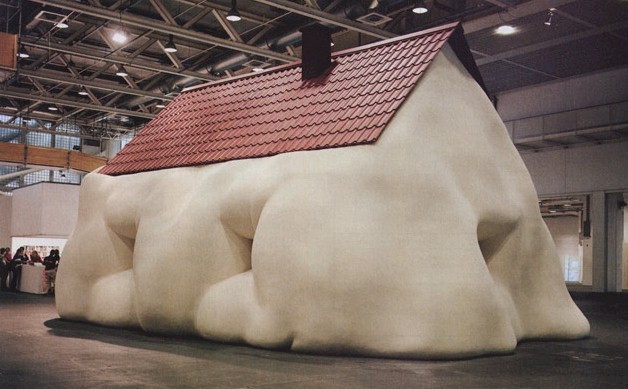
Austrian artist Erwin Wurm, creates works which liberate objects from their familiar context, giving them new meaning. Objects acquire illogical shapes and appearances, and the resulting distance created between us and the everyday raises fundamental questions about art, culture and the truths we take for granted.

Fat House (2003) is a life-size fantasy, cartoon house and forms part of the Fat series, which questions what minimum characteristics an object requires to be considered sculpture.

Truck(2005), on the other hand, takes the form of a vehicle curved up and fixed to the wall of the gallery space. Both works investigate with humour and sophistication how everyday objects can become sculpture, inviting us to reconsider the world we inhabit.

Art e-Facts 26

According to its proponents, dada was not art — it was “anti-art“. Dada sought to fight art with art. For everything that art stood for, Dada was to represent the opposite. Where art was concerned with aesthetics, Dada ignored aesthetics. If art were to have at least an implicit or latent message, Dada strove to have no meaning — interpretation of Dada is dependent entirely on the viewer. If art is to appeal to sensibilities, Dada is to offend.

It is ironic that Dada became an influential movement in modern art, a commentary on order and the carnage Dadaists believed it wreaked. Through this rejection of traditional culture and aesthetics they hoped to destroy traditional culture and aesthetics.

Art e-Facts 25


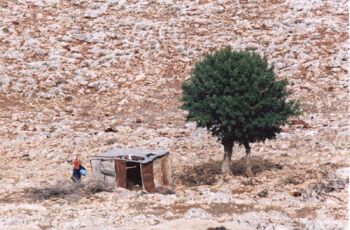
The photographic works of Palestinian artist Ahlam Shibli (*1970, “Arab al-Shibli”, Palestine) deal with current living conditions of the Palestinian population living in Israel and with the various consequences arising from living together in a state of permanent conflict.

Shiblis’ intention to show the everyday life of the Palestinian population requires intensive research on location, interviews with the villagers and the subtle observation of the rural and the urban environment.

An exhibition of Shiblis work can currently be seen at Dundee Contemporary Art Centre until April 1st. The exhibition comprises two vast sets of photographs which characterise her thoughtful, compelling practice.

In the two groups of photographs presented – Goter and Trackers – the people depicted are all – like Shibli herself – Arabs of Bedouin descent.

http://www.annadwa.org/cave/gallery_archive/ahlam_shibli.htm

http://www.dca.org.uk/exhibitions/current.asp