Born in Port Arthur, Texas in 1925, Robert Rauschenberg imagined himself first as a minister and later as a pharmacist. It wasn’t until 1947, while in the U.S. Marines that he discovered his aptitude for drawing and his interest in the artistic representation of everyday objects and people. After leaving the Marines he studied art in Paris on the G.I. Bill, but quickly became disenchanted with the European art scene. After less than a year he moved to North Carolina, where the country’s most visionary artists and thinkers, such as Joseph Albers and Buckminster Fuller, were teaching at Black Mountain College. There, with artists such as dancer Merce Cunningham and musician John Cage, Rauschenberg began what was to be an artistic revolution. Soon, North Carolina country life began to seem small and he left for New York to make it as a painter. There, amidst the chaos and excitement of city life Rauschenberg realized the full extent of what he could bring to painting.
Month: March 2007
Art e-Facts 37
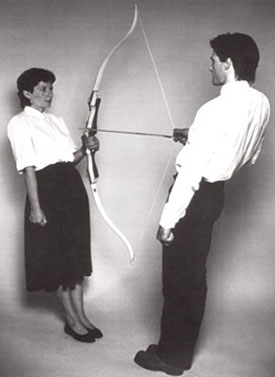
In 1976 Marina Abramović and Ulay began a decade of collaboration, during which the main concepts they explored were the ego and artistic identity.
Each performer was interested in the traditions of their cultural heritages and the individual’s desire for ritual. Consequently, they decided to form a collective being called “the other,” and spoke of themselves as parts of a “two-headed body.” They dressed and behaved like twins, and created a relationship of complete trust.
Rather than concern themselves with gender ideologies, Abramović/Ulay explored extreme states of consciousness and their relationship to architectural space.
In discussing this phase of her performance history, Abramović has said: “The main problem in this relationship was what to do with the two artists’ egos. I had to find out how to put my ego down, as did he, to create something like a hermaphroditic state of being that we called the death self.”
To create this “Death self,” the two performers devised a piece in which they connected their mouths and took in each other’s exhaled breaths until they had used up all of the available oxygen. Precisely seventeen minutes after the beginning of the performance they both fell to the floor unconscious, their lungs having filled with carbon dioxide. This personal piece explored the idea of an individual’s ability to absorb the life of another person, exchanging and destroying it.
In 1988, both artists walked the Great Wall of China, starting from the two opposite ends and meeting in the middle. As Abramovic described it: “That walk became a complete personal drama. Ulay started from the Gobi desert and I from the Yellow Sea. After each of us walked 2500 km, we met in the middle and said good-bye.”
This marked the end of their relationship.
Art e-Facts 36
Martin Boyce came to prominence during the 1990s and is one of Scotland’s most internationally acclaimed artists. His work takes inspiration from the collapse of utopian ideals that once surrounded mid-century modernism and modernist design. In past works, Boyce has re-situated iconic modernist furniture in anti-heroic postures, and in Double Black Disaster (1999), an Eames chair is put to work as a door jam.
Boyces’ work can currently be seen at The Modern Instutute in Glasgow until March 30th and later this year in Sculpture-Projects, Munster 07.
Art e-Facts 35
‘The one thing to say about art is that it is one thing. Art is art-as-art and everything else is everything else. Art-as-art is nothing but art. Art is not what is not art.’
This opening statement from the article ‘Art as Art’ by American Abstract painter Ad Reinhardt clearly advocates the complete seperation of art from life. He goes on to suggest that art should be:
‘…non-objective, non-representational, non-figurative, non-imagist, non-expressionist, non-subjective.’
This advocation of pure abstraction provided a conceptual platform for the ‘pure’ abstract paintings Reinhardt had been working on since the early 1950’s.
The article was first published in Art International, VI, no 10, Lugano, December 1962.
FOR INFORMATION ON FINE ART COURSES IN EDINBURGH PLEASE CLICK HERE
Art e-Facts (supplemental)
THE EDITOR WOULD LIKE TO APOLOGISE TO THOSE WHO NOTICED THE LACK OF FArt e-Facts OVER THE WEEKEND. THIS WAS DUE TO ILL HEALTH.
HOWEVER AS A RESULT THE EDITOR HAS DECIDED THE WEEKENDS ARE BETTER SPENT:
- IN THE STUDIO MAKING WORK.
- VISITING GALLERIES.
- READING AND NOT REMEMBERING.
- HAVING FAMILY FUN DAYS.
- BEING IN BED.
- BEING IN BED BEING ILL.
THEREFORE FACT OF THE DAY WILL ONLY APPEAR MONDAY TO FRIDAY.
 Contemporary Art Practice etc...