Art e-Facts 24


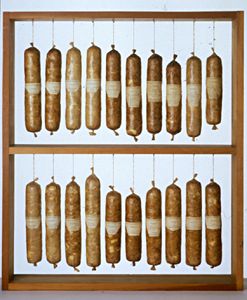
The German Swiss artist Dieter Roth (1930 – 1998) was an early pioneer of degradable artworks and made his first ‘baked’ sculpture in 1954. He went on to experiment further and made sculptures from chocolate, bread and other decomposable food stuffs. Remarkably, a significant number of the works still exist today. However, his artistic ouvre went much further than this use of edible materials and he also produced drawings, films, paintings and collaborated with a number of other artists including Richard Hamilton and Arnulf Rainer.

www.dieter-roth-museum.de/en/

Courtesy: J. Temple & C. Walker

Art e-Facts 23

Aberdeen born Michael Clark (1962) is one of the worlds leading contemporary Dancers and Choreographers. He was classically trained at the Royal ballet but was highly immersed and influential in the artistic club and sub culture of the 1980’s. His performances are highly visual and often have specific references to contemporary art, for example the projection of Andy Warhol’s “Liz” and “The Great Rock and Roll Swindle” by Julien Temple in the production of Mmm…

Clark choreographs pieces to an eclectic range of music including The Fall, Laibach, Wire, Public Image Ltd., Stephen Sondheim, Sex Pistols and Igor Stravinsky. His practice is often collaborative and he has worked closely with Video Artists, Fashion Designers and Musicians including Charles Atlas, Leigh Bowery, Trojan, Bodymap, Sarah Lucas, The Anthony D’Offay Gallery and Mark e Smith and the Fall.
http://www.michaelclarkcompany.com/

Courtesy: N. Manning

Art e-Facts 22

Leeds born artist Marcus Harvey is best known for his large work depicting Moors murderer Myra Hindley, formed from white, grey and black stenciled handprints of children. This work was the centre of major controversy when it was installed at the 1997 Sensation exhibition.

The reaction to the work raised questions about the censorship of art and the legitimacy of using such controversial imagery. The painting had to be placed behind protective acrylic glass after it was attacked with ink and eggs by protestors.

Art e-Facts 21


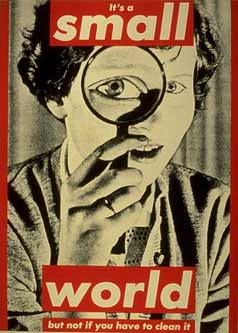
In 2005 Barbara Kruger was honoured at the 51st Venice Biennale with the “Golden Lion” for Lifetime Achievement.

Much of Kruger’s graphic work consists of black-and-white photographs with overlaid captions set in white-on-red Futura Bold Oblique. The phrases included in her work are usually declarative, and make common use of such pronouns as “you,” “I,” “we,” and “they.” The juxtaposition of Kruger’s imagery with text containing criticism of sexism and misogyny and the circulation of power within cultures is a recurring motif in the work.

Kruger is currently a professor at the University of California at Los Angeles.

http://www.barbarakruger.com/

Art e-Facts 20


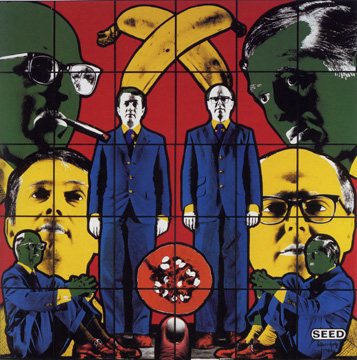
Gilbert & George place themselves, their thoughts and their feelings at the centre of their art, and almost all of the images they use are gathered within walking distance of their home in London’s East End. Yet their pictures capture a broad human experience, encompassing an astonishing range of emotions and themes, from rural idylls to gritty images of a decaying London; from fantastical brightly-coloured panoramas to raw examinations of humanity stripped bare; from sex advertisements to religious fundamentalism.

http://www.tate.org.uk/modern/exhibitions/gilbertandgeorge/